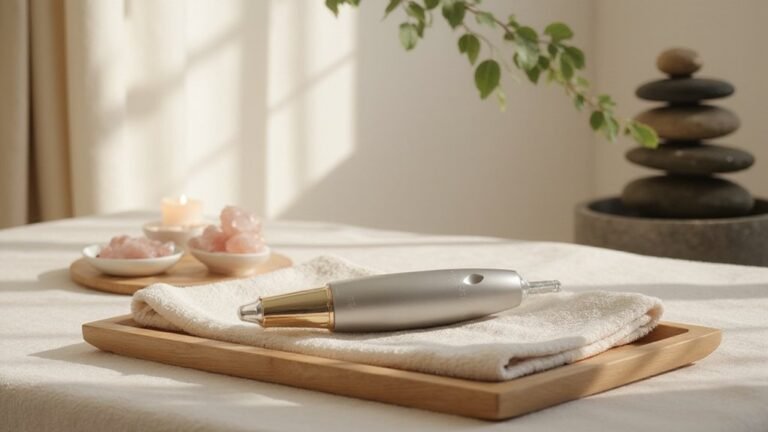
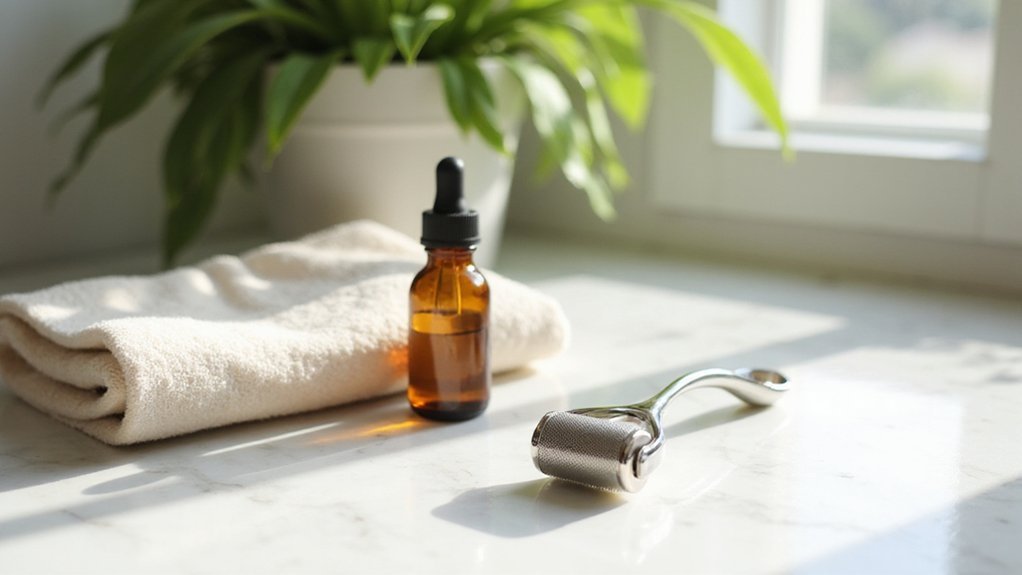
Wondering how to safely use a derma needle roller at home? The process involves simple steps to prepare your skin, choose the right needle size, and gently roll to stimulate collagen production.
Doing it correctly can help improve skin texture and firmness over time. Keep reading to learn exactly how to get the best results.
How to Prep Your Face and Tool for Safe Derma Rolling
To prep your face and tool for safe derma rolling, start by cleansing your skin with lukewarm water and a mild, non-stripping cleanser suited to your skin type. Avoid harsh foaming cleansers or exfoliants that can irritate your skin. Pat your face dry with a clean towel—never rub, as this can cause micro-tears or irritation. The roller’s micro-needles create controlled micro-injuries that trigger the skin’s natural repair process during treatment. After each use, you should also rinse the roller under warm water to remove any residual serum or debris before the alcohol soak.
Next, disinfect your derma roller by soaking it in 70% isopropyl alcohol for 5 to 10 minutes. After soaking, let it air dry completely without wiping, to maintain its sterility. Similarly, wipe your skin with 70% alcohol or an antiseptic wash, then allow it to air dry fully. This creates a bacteria-free environment and reduces the risk of infection. A pre-session waiting period of approximately 23 minutes is fundamental to prepare the skin properly for optimal results. Ensuring the needles are clean prevents contamination from titanium dioxide particles that can settle during manufacturing.
Before rolling, stop using retinoids, AHAs, BHAs, benzoyl peroxide, and strong vitamin C serums at least 3 to 5 days prior. Avoid rolling over active acne, open sores, eczema, sunburn, or rosacea flares. For better control and protection, divide your face into sections during preparation, ensuring each area is thoroughly cleaned and disinfected before treatment. This rolling process works by physically piercing the stratum corneum to enhance active ingredient absorption.
Which Needle Length Should You Start With?
The best needle length to start with is either 0.25mm or 0.5mm. For beginners, 0.25mm is the most conservative choice. It is ideal for sensitive scalps or those new to microneedling, focusing more on serum absorption rather than deep stimulation. The 0.5mm needle length is a balanced option, suited for early signs of thinning hair. It provides gentle stimulation and helps support product efficacy without significantly increasing discomfort or healing time. Both options are minimally invasive and reduce the risk of irritation. Avoid starting with longer needles such as 0.75mm or 1.0mm, as they carry higher risks of pain and require professional guidance for safe use. If you feel nervous, opt for 0.25mm, but for mild hair loss, 0.5mm is generally suitable. LED masks offer a non-invasive light therapy alternative that can complement microneedling by enhancing skin recovery and collagen production. Proper tattoo machine setup principles, including adjusting needle depth and speed, can also inform safe microneedling practices for consistent pressure and reduced skin trauma. Following a proper aftercare routine for your scalp is essential to prevent infection and maximize results after microneedling.
How to Roll in Horizontal, Vertical, and Diagonal Patterns
You should use horizontal, vertical, and diagonal strokes when rolling a derma needle roller to create a comprehensive grid of micro-channels across your scalp. Start with horizontal passes from left to right, focusing on temples and side zones for efficient coverage. Next, switch to vertical strokes perpendicular to your first pass to ensure you catch any missed follicle rows. Finish with diagonal slants, alternating both directions, to cover angles that might be overlooked in previous passes. The entire schedule depends on the needle size you select, as smaller needles allow for more frequent use while larger needles require longer recovery time. Similar principles of even distribution apply to white ink tattoos on dark skin to avoid patchy results.
This pattern ensures even distribution of pricks and prevents over-concentrating along a single line. Rotate the roller after each pass to avoid dragging or applying uneven pressure. Work on small sections at a time, completing all passes in one direction before moving to the next, which helps in building a precise grid without overlapping your channels unnecessarily. This deliberate sequence maximizes scalp stimulation, targeting all potential follicle areas systematically. Selecting the proper needle length is essential for effective treatment without causing unnecessary trauma. Always disinfect the Derma roller before use to prevent infections.
How Many Passes and How Much Pressure Should You Use?
Use 4 to 8 passes per area, moving in each direction. This ensures thorough coverage without overdoing it. Lift the roller between passes instead of dragging it across the skin, helping to prevent scraping. Choosing the right needle size aids in achieving effective results with minimal force. For instance, using white ink over a blackwork tattoo requires understanding that the white may appear as a subtle highlight rather than a solid color.
Apply light pressure—letting the roller’s weight do most of the work. You should feel a tingling sensation, not pain. Mild redness or pinkness indicates proper stimulation, but stop immediately if you see bleeding or deep redness. Over-rolling can irritate the tissue, so limit yourself to 4 passes per direction on thinner facial zones. Keep your angle close to 90 degrees and maintain even, controlled pressure across each section for consistent results. For best results, avoid applying the roller over fresh tattoo ink that is still healing.
What to Do Immediately After Using a Derma Roller
Immediately after using a derma roller, your skin’s micro-channels are open and vulnerable. It’s best to avoid washing or applying active products right away. If your protocol permits, gently rinse with water after a few minutes, but skip cleansers for at least 4 to 6 hours; for scalp treatments, wait up to 24 hours. Apply only fragrance-free hydrating products like hyaluronic acid or panthenol, followed by a gentle moisturizer. Avoid retinol, vitamin C, acids, and minoxidil for at least 24 to 48 hours, as these can cause irritation and slow recovery. Stay out of direct sun, hot showers, and strenuous exercise for a day. Keep your hands off your face, pat your skin dry gently, and change your pillowcase to a clean one. Mild redness and warmth are common side effects but are temporary. Monitoring irritation is important, and sticking to this routine helps enhance long-term benefits such as smoother skin texture and more even tone. Consistent aftercare also supports collagen induction therapy, which is the primary mechanism behind the skin’s rejuvenation. Understanding the depth and speed settings of your device, much like tattoo machine types, helps you match needle penetration to your skin’s tolerance for safer, more effective sessions.
How Microneedling With a Derma Roller Boosts Collagen
Microneedling with a derma roller stimulates collagen production by creating controlled micro-injuries that signal your body to repair itself. These tiny punctures penetrate the skin without causing surface damage, triggering a wound-healing response that activates fibroblasts to produce new collagen and elastin. This process also involves an influx of growth factors like transforming growth factor, which guide collagen deposition and reorganization. As a result, the skin’s internal structure improves, increasing the levels of collagen types I, III, and VII. This leads to firmer, smoother skin. Research indicates that with four monthly sessions, collagen production can increase by up to 400%, enhancing skin texture, firmness, and the appearance of scars. Additionally, new blood vessels form, boosting nutrient delivery and supporting overall skin health. All of this occurs gradually through those precise, controlled micro-injuries, making your skin stronger and more resilient over time. Needle lengths are adjusted based on the depth of skin damage to ensure the micro-injuries reach the dermis where collagen production occurs.
How Often Can You Use a Derma Roller by Needle Size?
The frequency with which you can safely use a derma roller depends on the needle size. For a 0.25mm roller, you can use it every other day or 2–3 times weekly to enhance absorption of skincare products without significant downtime. A 0.5mm roller is best used once or twice a week, with at least 24 to 48 hours between sessions to allow your skin to recover. When using a 1.0mm roller, spacing sessions every 10 to 14 days is advisable, giving your skin ample time to heal fully. For larger needles, such as a 1.5mm roller, limit use to once every three to four weeks, and professional supervision is often recommended, similar to how professional tattoo machines require expert handling for safety. Always monitor your skin’s response and extend your intervals as needed to prevent irritation or redness. Prioritizing complete healing over sticking to a rigid schedule will yield the best results and minimize potential damage. For precise stencil application, consider using a top tattoo stencil printer to ensure clean, consistent transfers. Just as tape extensions offer semi-permanent convenience compared to clip-ins, larger needle rollers require more commitment and recovery time than smaller ones for optimal results.
How to Sanitize Your Derma Roller Before Each Use
To sanitize your derma roller properly before each use, start by rinsing the roller head under cool running water to remove any surface debris. Next, fully submerge the needles in 70% isopropyl alcohol for at least 5 to 10 minutes; lower concentrations or alternatives like hand sanitizer are ineffective and should be avoided. After disinfecting, allow the roller to air-dry head-down on a clean, lint-free surface—never use towels or apply heat, as these can damage the needles. Beginners should note that adjusting your tattoo machine for proper needle depth is a similar principle to ensuring the derma roller’s needles penetrate evenly without causing unnecessary trauma. Store the sanitized roller in a dedicated, clean container to prevent dust and contaminants from coming into contact with it. Always use fresh alcohol and avoid reusing cleaning solutions. Before each session, inspect the needles closely to ensure they are clean, free of rust, and undamaged. Proper sanitization protects your skin from infection and ensures the longevity of your device. Alcohol kills up to 99% of microorganisms, so using 70% strength is critical for effective disinfection. For maximum safety, consider gentle removal techniques that minimize skin irritation when handling tools near sensitive areas, just as you would with adhesive-based beauty products. However, unlike a derma roller, professional microneedling devices often use automated needle cartridges for deeper and more consistent penetration.